Wednesday, March 6, 2019

VITAL RECORDS

The third in a series of instructional genealogy research blogs.


From Wikipedia:

Vital records are records of life events kept under governmental authority, including birth certificates, marriage licenses, and death certificates. In some jurisdictions, vital records may also include records of civil unions or domestic partnerships. In the United States, vital records are typically maintained at both the county and state levels.


Vital records are the framework, or the bones, that our family history is built on. The dates and locations for the deaths, marriages and births of our ancestors is the bare minimum we try to collect on each individual. Vital records can help direct your research in the right direction.Pursuing these records starts early in the research process and NEVER stops!

Primary vs. Secondary Sources:

The documents which are created at the time of the event by people who should have personal knowledge of the event, are primary source material for the event being recorded. The best example of this is the death certificate. The person who provides the information on the death was present at the death or in the days leading up the the death. It is a primary source for that person's death information.
 Besides recording information on the death, a death record usually also contains a spouse's name and the individual's birth date and parents' names, but it is considered a secondary source for the information on the individual's marriage and birth information. Secondary sources are created long after the event or by someone who would not have direct knowledge of the event. The person providing information on the death would not have been present at the time of the birth or marriage.

Primary source materials are always the preferred source.

Keep in mind:
  • When acquiring vital records for an individual, work from the most recent, death, to the earliest, birth. 
  • In the United States, these records are maintained by a clerk in the city, town, county or state where the event took place. 
  • Since around 1900 (varies by states) most states keep the records of these events. 
  • You may not have access to some records, such as recent birth records, due to privacy concerns.

Map showing dates that each state went to statewide registration of births, marriages and deaths.
Registration might be at the county or town level prior to these dates.

DEATH RECORDS

  • Originally deaths were registered to compile medical statistics on epidemics. 
  • Even after registrations were required, compliance with the law was haphazard and incomplete. 
  • The information about the death will probably be accurate, but other events reported on the records, such as birth date, parents and spouse may contain errors, depending on who provided the information. 
  • Death records only exist in the United States for approximately the last 150 years. 
  • Prior to around 1900, look for death records at the county or city level. 
  • After 1900, check the state level for death records. The farther back in time you go, the less information you will find on a death record. 
  • Good sources for finding dates that death records were required are the Redbook and VitalRec.com
This Certificate of Death is from 1959 in Ohio. It is a wealth of information.
But as we will see in other documents, it does not tell the whole story.

Alternatives to official Death Records

  • Sometimes, an official death record is not available or doesn't exist. When this happens, you need to turn to other sources. Ideally, you would use multiple sources to verify the death information. 
  • Obituaries, while not official records of death, can contain valuable family information. 
    • Check all obituaries for errors, due to incorrect information being given by the informant and typographical errors. Obituaries can be the one place where all the pertinent facts of a person’s life are revealed. 
    • Earliest newspapers tended to only report the deaths of the most prominent citizens. Late in the 1800’s, obituaries became more common for everyone. 
    • Obtain obituaries not only for your direct ancestor, but for their siblings, wives and children. 
    • Obituaries are best obtained from the local library that holds microfilmed copies of the local papers. 
    • Many indexes for obituaries are online. 
    • There are online databases for obituaries that cover the last 20-25 years.
      This obituary from the Gallipolis (Ohio) Journal,
      dated 26 June 1959 reveals that Lunas Johnson,
      from the above death certificate, died alone at
      home and his body was not discovered for
      "a considerable time." So his date of death is
      estimated.
  • Probate Records – Closing out the estate of someone happens only after they have died. Can also reveal wives and children. 
  • Cemetery Records – besides the tombstones, various other records exist in relation to burial of an individual, such as plot deeds, plat records, sexton’s records, and grave opening orders. While a tombstone should be accurate as to the date of death, it may not be as accurate for date of birth. 
    • Catholic Cemetery Association (Cleveland Area)
      • http://www.clecem.org/
      • Relatively new site 
      • Registration is free 
      • Registration is necessary for searching 
      • Can search where someone is buried 
      • Sometimes can view section map that will precisely locate grave site
  • Social Security Death Index - while this is not a true substitute for a death record, it can help you determine in what location to find a death record. http://search.ancestry.com/search/db.aspx?dbid=3693 or at https://familysearch.org/search/collection/1202535 
  • Funeral Cards 
  • Mortality Schedules – for the 1850-1880 Census enumerations, there are also lists of people who had died in the 12 months prior to the census being taken. Available on Ancestry Library Edition and FamilySearch.org

MARRIAGE AND DIVORCE RECORDS  

  • Marriages were required to be registered much earlier than births and deaths, as a rule. Marriage records come in various forms, such as marriage licenses and marriage certificates. These documents will provide the maiden name of the woman. They are most often filed at the county courthouse. 
  • In New England, town clerks began registering marriages in the 1600s and in the South, in the 1700s. Only much later are the parents names included on a marriage record. Information on a marriage record can be inaccurate, due to the couple falsifying their ages, etc. Consent affidavits would have to be filed if either of the parties were under aged at the time of the marriage. 
Besides learning the names of the parties involved, the date and place of the event and the parents names, we
learn so much more from this 1918 marriage record from Gallia County, Ohio.
 Both William Tecumseh Sherman Johnson and Stella Belle Berry used their middle names.
Lunus' first name is misspelled and his signature is illegible. Could he have been illiterate?

  • Marriage banns were required by some church denominations. They were usually read aloud on three consecutive Sundays in church. They might also be posted in a public place. It was an opportunity for any objections to be raised. 
  • Bonds would be posted prior to the marriage. It was money set aside to defray expenses in case in the event the marriage didn’t take place. The money was posted by the groom or his father. Marriage bonds are NOT positive proof that a marriage took place. 
  • Church records 
  • Bible Records 
  • Newspaper announcements
  • Unofficial unions usually have no official documentation. 
    • Should be noted for a complete view of a person’s life. 
    • MOST important if the union results in any children. 
    • Documenting and displaying this information is a matter of personal preference.


DIVORCE
  • In a divorce, the date of the marriage is usually given. 
  • Divorce legislation has always varied greatly from region to region and state to state. 
    • New England states granted divorces from an early time period. 
    • Southern states had more restrictive divorce laws. South Carolina did not grant divorces until 1949
  • Earliest divorce records were handled by state governments
  • As divorces became more common, the legislatures passed the work load onto the county court systems. 
  • Divorce records could be handled by; Superior Court, Equity Court, Probate Court or Family/Domestic Court 
  • Certain areas became divorce “meccas” because of easy access and the laws were less restrictive 

BIRTH RECORDS

  • Only exist in the United States for approximately the last 150 years. The farther back in time you go, the less information you will find on a birth record. 
  • Prior to around 1900, look for birth records at the county level. Except for New England states, where the birth records are found at the town level. 
  • After 1900, check the state level for birth records. 
  • Delayed birth certificates were issued many years after the birth in cases where the person: 
    • Was born prior to the keeping of birth records 
    • Was not registered due to non-compliance. 
    • Needed proof of birth to register for Social Security benefits.

Alternatives to Official Birth Records

Baptism records can stand in for birth records
where a birth record doesn't exist.

  • Baptism or christening ceremonies have to be carefully checked. Often they only record the date of the ceremony, not the date of the birth. 
  • Birth announcements in newspapers. 
  • Bibles often have births, deaths and marriages. Check to see if the handwriting is the same throughout. If it is different, the events were likely recorded as they occurred. Check with family members, local and regional historical societies. http:///www.learnwebskills.com/patriot/biblerecords.htm
  • Military pensions or muster rolls - often the approximate birth date had to be given. 
  • Census records – The later census records state the age of each individual, but the earlier ones only state the age range of people. But the information can be unreliable.

WHERE TO LOCATE VITAL RECORDS

BOOKS:

WEBSITES:
STATE VITAL RECORDS; Examples:
  • Once your have your record, document the source of the information. Where did you get the records, when did you get it, etc. 
  • Do not fold it. Place it in an acid free sleeve. 
  • Store the original document in a safe place. 
  • Scan it or make a copy to use when sharing or researching.

Wednesday, February 27, 2019

The Dreaded COMMON SURNAME!

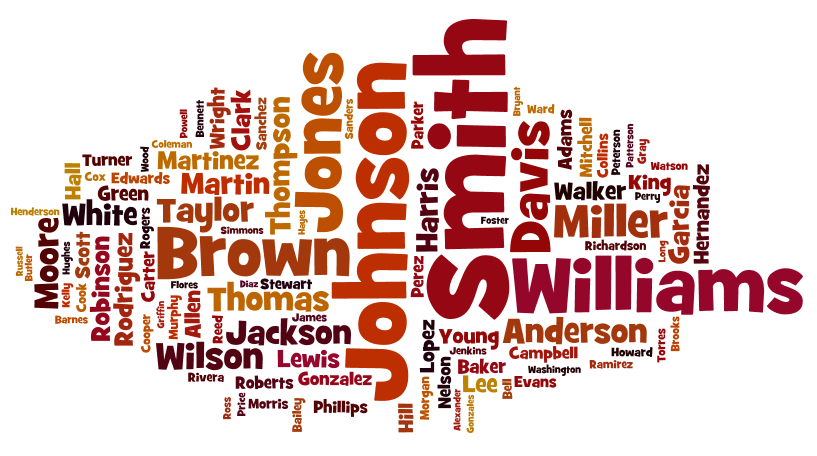
Common surnames can be difficult to research. I understand that all too well, with my maiden name being JOHNSON, and MASONs, TANNERs, YOUNGs, and WILLIAMs heavily populating my family tree. And yes, I have a SMITH line also.


Image result for common us surnames
Image courtesy Behind the Surname
So how do you ferret out your William JOHNSON or John MASON from all the others that are contenders for being your ancestor? Organization and Persistence.

STRATEGIES 
  1. Always, ALWAYS start with yourself and carefully work backward into the past, one generation at a time. Don't skip any information. Document all information that you think you know. Don't leave any resource unchecked.
  2. Create a profile of your farthest back ancestor that details every bit of information that you know about him, or her, so that you can pick him out in a crowd of like named people. Know where he died and is buried, know all the places he lived in his life. Know his wife, siblings and children. His occupation. Where his land was. EVERYTHING.
  3. Research his community, often called his FAN club - his Family, Associates, and Neighbors. People tend to move and act along with others. Look at their wills, land records marriages and births.These "others" could provide clues to your ancestor's life.
  4. Focus on the location where you know your ancestor lived. This narrows your focus considerably.
  5. Research everyone with the same surname in a locality. You might find a link to your family.
    I have not identified the parents of my 3X great grand father, John Williams.
    From later accounts, John Williams, born 1796,  moved to Gallia County Ohio, 
    with his parents, at an "early age"  and prior to his marriage there in 1818. 
    His the third listing down from this abstract from the 1820 Census 
    for Gallia County, from Ancestry Library Edition. All eight of  the other names are
     candidates to be his father and need to be researched.
  6. Identify someone in the family with a unique first name. This will help distinguish your ancestor from others of the same name. America MASON helped me trace my William MASON.
  7. Create spreadsheets and charts to track all the people with the same name in the same area. This helps you keep them separate. I used an Excel spreadsheet to tease out which of the 3 Thomas Barry's in Noble County Ohio was my ancestor.
  8. Land Records - tracing the passing of land from one generation to the next helps prove  ancestry. This method was used to prove that my William P. Williams, husband of Rebecca (TAGG) Williams was the son and heir of John Williams of Gallia County, Ohio and supported my entry into First Families of Ohio.
  9. Tweaking your searches. When possible, use Boolean search techniques to refine your search. This works when using Google and some databases:
    • If the surname is the same as a place, color, thing, occupation, use the "-" limiter to narrow your results. Berry -Straw will eliminate the fruit. Mason -stone will eliminate the occupation, etc.
    • Use the Exclude Words and Include Words fields to eliminate common phrases. Not all databases offer this search field
    • Quotation marks to create a phrase "William H. MASON" to search for an individual. Not all databases search boxes allow special characters like quotation marks and periods.
    • Add a location or time period.
    • Use the "and", "not", and "or" Boolean operators. Ex. "Baker NOT Bread"
    • Search using the common abbreviations for first names. Ex. "Jno" for John, "Geo" for George, "Wm" for William and "Jas" for James. 
    • Search using nicknames. Ex. "Billy", "Betty" and "Johnny" (My Dad's friends at work called him Johnny even though his first name was Lawson. "Johnny" came from his last name - Johnson.)
  10. DNA testing. You could use DNA testing to connect with others researching the same line.
  11. Be persistent and don't give up the search. You may have to let it rest for awhile, but always come back to the common name ancestor.
SOURCES:
  • "Any Tips for Tracing an Ancestor With a Common Name?", The Root, Henry Louis Gates Jr. Web. 22 May 2015. 13 Feb. 2019. 
  • "Common Surnames in the United States." Behind the Surname, Mike Campbell. Web. 13 Feb. 2019.
  • "First Families of Ohio (FFO)", Ohio Genealogical Society.Web. 13 Feb. 2019. 
  • "Genealogy Case Study; Researching Common Surnames Online", Family Tree Magazine. Nancy Hendrickson. Web. 11 Feb. 2014. 14 Feb 2019.
  • "How to Research Your Common Surname Ancestors", Are You My Cousin? Lisa Lisson. 13 Feb 2019. 
  • "List of most common surnames in North America." Wikipedia, The Free Encyclopedia,  1 Feb. 2019. Web. 13 Feb. 2019.
  • "Refining Google Surname Searches", Family Tree Magazine, Nov. 2010, pp. 70-71. Web. 13 Feb 2019.
  • "Tips to Find Ancestors with Frustratigly common Surnames", Ancestral Findings. Web. 14 Feb. 2019.

Wednesday, February 20, 2019

THE LEGAL GENEALOGIST - My Favorite Blog

Image courtesy of ccPix.com


Ever since Pat Morgan of the Medina County Genealogical Society recommended it to me, I have been a huge fan of The Legal Genealogist blog.


 Its stated purpose is to  "help folks understand the often arcane and even impenetrable legal concepts and terminology that are so very important to those of us studying family history." It does that and so much more, EVERY DAY!

The Legal Genealogist is the creative achievement of Judy Russell. Judy's training and background are quite impressive. (Check out the list of her qualifications at the bottom of this blog.) She describes herself as a "genealogist with a law degree." I love that she puts being a genealogist first!

Judy Russell, aka The Legal Genealogist
Photo courtesy Judy Russell.


BUT...

She cannot answer legal questions. SHE CANNOT AND WILL NOT ANSWER LEGAL QUESTIONS. She is not your lawyer.


Once you understand that, here are some of the reasons that her blog is #1:
  1. It is delivered to my email in-box every day.  Let me repeat that - EVERY DAY. I don't have to go looking for it. It appears like magic. Occasionally I will delete the posting without reading it, but that is rare.
  2. She explains legal terminology and concepts in a way that I can understand. This is an area of weakness for me, but she makes it comprehensible.  Here is an example: https://www.legalgenealogist.com/2019/01/31/the-thing-and-the-rights/
  3. DNA on Sundays - every Sunday, the blog is about DNA testing. Again, Judy makes these very complex concepts intelligible to me.
  4. Poignant sketches of her family. Genealogists have weak spots for touching family stories. I am no exception. Neither is Judy. 
  5. Methodology - the "how-to's" of genealogy. There is always more to learn.
  6. Access to records - Judy is an advocate for open access to records. And she raises the awareness of others (like me) to threats to that access and recommends a course of action to advocate to keep records open.
  7. She revisits concepts like "terms of use",  privacy in genealogy, and copyright law regularly. 
  8. She is a dynamic speaker. The Ohio Genealogical Society has hosted Judy at their annual conferences several times. Hers is one of the "don't-miss" sessions, no matter what the topic.
  9. Whenever Judy is really busy, her blog will feature the ABC's of legal terms. Judy is often quite busy, but I never feel cheated when her blog is a definition. Because Judy always makes it interesting, and...
  10. She is funny.
Subscribe to her blog for daily emails at: Daily Legal Genealogist Email


Oh, and what is your favorite genealogy blog??

JUDY'S BACKGROUND

Judy has a bachelor’s degree in journalism from George Washington University in Washington, D.C. and a law degree from Rutgers School of Law-Newark.
As a genealogist she is a Colorado native with:
  • Deep southern roots on my mother’s side 
  • First generation German on my father’s side. 
Employment history:
  • Newspaper reporter 
  • Trade association writer 
  • Legal investigator 
  • Defense attorney 
  • Federal prosecutor 
  • Law editor 
  • Adjunct member of the faculty at Rutgers Law School, for more than 20 years 
  • “Retiree” as of 2014 
  • Lecturer at genealogy conferences across the country. 
Genealogical Education:
  • Two decades learning the trade as a genealogist, (see below) 
  • Has attended the National Institute on Genealogical Research at the National Archives in Washington, D.C., and completed courses in: 
    • Advanced Methodology and Evidence Analysis 
    • Writing and Publishing for Genealogists 
    • African American Research 
    • DNA analysis and more 
  • Credentials as a: 
    • Certified Genealogist® 
    • Certified Genealogical LecturerSM from the Board for Certification of Genealogists® 
    • A member of: 
      • The National Genealogical Society 
      • The Association of Professional Genealogists 
      • The state genealogical societies of New Jersey, North Carolina, Virginia, Texas and Illinois, among others. 
  • She now to serves on: 
    • The faculty at the Institute of Genealogy and Historical Research (IGHR)
    • The Salt Lake Institute of Genealogy (SLIG)
    • The Genealogical Research Institute of Pittsburgh (GRIP)
    • The Midwest African American Genealogy Institute (MAAGI) 
    • The Genealogical Institute on Federal Records (Gen-Fed)
    • A member of the Board of Trustees Board for Certification of Genealogists®  
Publications:
  • National Genealogical Society Quarterly (see Judy G. Russell, “`Don’t Stop There!’ Connecting Josias Baker to His Burke County, North Carolina, Parents,” National Genealogical Society Quarterly 99 (March 2011): 25-41. 
  • The award-winning “George Washington Cottrell of Texas: One Man or Two?,” National Genealogical Society Quarterly 105 (September 2017): 165-179. 
  • The National Genealogical Society Magazine (see Judy G. Russell, “Autosomal DNA testing,” National Genealogical Society Magazine, October-December 2011, 38-43.
  • “Fifty years of credentialing,” National Genealogical Society Magazine, January-March 2014, 15-19. 
  • “Shootout at the Rhododendron Lodge: Reconstructing Life-Changing Events,” National Genealogical Society Magazine, January-March 2015, 28-35. 
  • BCG’s OnBoard newsletter, among others. 
SOURCE: The Legal Genealogist Bloghttps://www.legalgenealogist.com/

Wednesday, February 13, 2019

AFRICAN AMERICAN GENEALOGY


In honor of Black History Month and in keeping with our 2019 theme of family history education, I am offering this brief tutorial on African American Genealogy.

First, please understand that I AM NOT AN EXPERT in this field.

Understood? Good!

Start your research the same way as any other genealogy research, with yourself. Work back through each generation using vital records, census records, oral family histories and newspapers. Those techniques are being highlighted once a month in this blog, but are also available in many, many places, both online and in books.

While not impossible, as Henry Louis Gates Jr. has proved time and again on his popular television shows, Faces of America and Finding Your Roots, African American genealogy presents unique challenges. Such as:
  • The brick wall of slavery. Prior to emancipation, slaves were not given surnames and not listed by name in typical records, such as census and vital records (births, deaths & marriages).
  • The use of nicknames. So will the record be under a nickname or given name? You will need to check under both.
  • Surname changes, particularly after the Civil War when the newly freed people had to pick a surname for the first time. Often, they chose the name of a previous slave owner, or someone they really admired like Lincoln or Washington. Later, people would change their surname to reflect major changes in their life. Like when Cassius Clay became Muhammad Ali to reflect his religious conviction.
  • Reticence to talk about bad times. While not unique to the Black community, it is more prevalent. Painful memories can deter relatives from talking about their ancestors.
  • For various reasons, African Americans have been under-documented in official records. That means that even when there should be a record, sometimes there isn't one.
  • Many southern states didn't start requiring registration of vital records until after 1900.
  • Enslaved people were not listed by name in pre-emancipation census records.
An unidentified African American Civil War soldier poses with his family
in this ambrotype from the Library of Congress.

The following are special records that can aid in researching African American ancestry:
  • Freedman's Bureau was set up after the Civil War to help the recently freed people with food, housing and education as the acclimated to their new status as free people. These papers are available on the Library database Heritage Quest Online.
  • Southern Claims Commison whose purpose was to reimburse southern Loyalists whose property was confiscated by the Union Army. Neighbors of all classes were questioned in these claims. Some can be accessed on Ancestry, the Family History Centers and Fold3.
  • American Slave Narratives - besides the personal accounts written by or about people who had been slaves, the Federal Government commissioned out of work writers to interview ex-slaves during the depression. They are available on the Library of Congress web site.
  • Property and probate records of slave owners - available in local court records.
  • African American newspapers - for example the Cleveland Public Library has a database that covers the Cleveland paper, The Call and Post for members with a card from the Cleveland Library. Also, after emancipation people would put notices in local newspapers trying to locate missing family members. Check the area newspapers for the time period.
  • Cohabitation Records –  Records found in Alabama, Georgia, Kentucky, Mississippi, North Carolina, Tennessee, and Virginia, were created to legalize marriages and legitimize children for people who had been enslaved. Found in local courthouses, state libraries, state archives, or county historical societies. 
  • Free Negro Registries – Prior to Emancipation, free African Americans were required to register proof of their free status in  many states, such as Delaware, Maryland, North Carolina, Ohio, Pennsylvania, and Virginia/West Virginia. These records are sometimes found in a separate book called “Registry of Free Negroes and Mulattoes” or in the county Minutes Books (court records). Some registers are published by the county and available for sale or found in libraries. Most are available by microfilm at state libraries or archives. Some county registers are also available online. 
  • Alabama 1866 State Census – The first count of all inhabitants of a state after the Civil War. Everyone in neighboring households may not necessarily be related, despite sharing the same surname. Available on Ancestry Library Edition 
  • African American Heritage database allows you to search records, books, serials, and other historical records specific to African Americans to trace your genealogy or to do research. Available from the Library's list of databases.

The Medina Library has these books to help your search:


Lastly, these web sites should be helpful:
As always, good luck in your research!


Tuesday, February 5, 2019

Organizing Your Genealogy Research

It's my turn to do a genealogy lesson! This is the second in a series of lessons on genealogy research.
-Lisa Rienerth - Guest Blogger - Kathy's co-worker


Does This Look Familiar?


Then it's time to organize your research! 

You might be asking.."Why should I organize my research? I know where everything is!"

However, if you organize your research, it will improve your chances of successfully finding those elusive ancestors and help you break through those pesky brick walls!

AND.....

 It is going to save you time! You won't be searching through piles of papers looking for that specific relative or old record you knew you put somewhere! You will be able to see what information you have and what you still need and where to find it, in just a glance! Names and places of repositories will be easily found and will come in handy if you need to search for records at a place you have already visited or communicated with.


It will save you money!  If your records are organized, you will be less likely to order a record you already have. It will also help keep you from driving to a far off repository you already visited, but are unable to locate the information you found there.


It will keep your research focused! If you have your families sorted and all of your sources sorted by family surname, it will make it easier to not only record the information, but also to see what is missing. It helps you focus on one surname at a time, so you don't end up jumping from one person to the next and never really finding anything in particular for anyone.


Now that I have convinced you that it is a good idea to organize your research (at least I hope I have), let me show you some easy steps to start your organizing....and no...I won't tell you to hold it up and see if it gives you a spark of joy!

First, If you are a beginner, or you have only been doing your research for a few years, you will need some 2" binders. You want a binder for each SURNAME to keep all of the information that pertains to that family. Put the surname on the spine of the binder, that way when you have them shelved, you can see the name at a glance.


 Use page dividers to keep the information organized within the binder. 

When you have so much information that it will no longer fit in the 2" binder or there isn't any room for one more binder on your shelves, it is time to move up to either a file cabinet or file box.


You will then divide the surnames up into separate hanging files, using file folders to separate the information.  Depending on how much information you have collected on a certain family, you may have to use multiple hanging folders for one surname.  Some researchers color code their files or use color coded file labels to keep the names and information organized.

Keeping separate binders/files for each family and their records is just the beginning of your organizing.

The next step is using certain forms to keep your research recorded and organized. Kathy showed you how to use and how important Ancestral charts and Family Group sheets are. These are just two of the forms you need to keep in your surname binder or file. 

Another important form is the Research Journal. The journal tracks the research you are planning to do and research you have completed. The Research Journal below is one I made in Microsoft Word with the Table tab.

This Research Calendar is from Ancestry.com

You can use any research form as long as it records who and what you are looking for, your plan to get the source, the date you completed your research along with the results. These types of forms help you keep organized in a few ways.

1. It keeps you focused on one person so you don't get distracted and forget who and what you are looking for.

2. It prevents you from repeating research you have already accomplished.

3. It retains information that you may need for future research. For example, ways to contact court houses or archives or how much you paid for a record.


TECHNOLOGY - Another Way To Organize!
                                                       
Please remember....DO NOT throw away any of your hard copies! Technology does not replace what you have, it is in addition to what you have. Things can go wrong with technology and you could lose too much research because of it. However, you can't keep your hard copy safe from a catastrophe either. I am a believer of storing your research in as many places as possible. 


A laptop or a tablet is a good place to save your research. You can scan your photographs and records and save them to files on your device. 


From your device you can save your research to a flash drive. This is a handy device which you can take when you travel to research facilities.  You will have all your information at your fingertips and  most places you can download information to your flashdrive as you find it. Just remember the flash drive is only good for about 8-10 years and will need to be replaced so you don't lose your research. 


External Hardrives are a great place to store your research and scanned photographs and documents. This way if your laptop's hard drive crashes or your USB gets lost you will still have your research.


Software is a wonderful tool to use to  keep your research organized.  Find a software program you feel comfortable with. The website, Top Ten Reviews, is a good place to start. It is a type of online consumer report and will have a list of the different software, a list of average prices and how well they do with certain options. 
Please disregard the prices. This is an outdated image.


Websites are another place you can download your information to. However, please read all the fine print to learn about their privacy settings and if there are any fees. A few websites which you might want to check out are: Ancestry.com, FamilySearch.org or MyHeritage.com. There are many more, but please be cautious with which one you use. 


The Mysterious CLOUD!
There really isn't anything mysterious.They work like your email accounts. The information you upload to the Cloud is kept on the company's server and you can access this information from the company's website on any device. 

Just like the websites and software, do your homework. Search for what is available and talk to others who use this as a way of storing their information. A few providers are: Dropbox, Google Drive, Microsoft Onedrive, and Apple iCloudJust like the websites, there are many Cloud providers out there, just be sure you know all of the privacy settings and fees.  Most of them give you free storage up to a certain amount and then they start to charge a fee to increase the storage. 

Oh...and just so you know...I am not being compensated in any way by mentioning the different websites and providers in this blog. They were used for example purposes only. 


I hope this helps you begin organizing your research! It may take you some time to put everything in order, but don't give up! Remember all the benefits it will provide you! 


Wednesday, January 30, 2019

DIARY UPDATE

Morgan Andrew's Diary

Since I first posted about the Civil War Diary of Morgan Andrews on December 5th, I have continued transcribing it, and within its pages additional information came to light about Morgan's death.

Morgan Andrew's Civil War Diary

In my previous posting I quoted what I thought were the last entries in the diary that were dated July 6-8 1862, in which Morgan very matter-of-factly says that he isn't feeling well for several days and then blank pages.  The image from the company roster said Morgan died on July 30 in Cumberland Maryland of disease.

Roster of the 84th Regiment, showing that Morgan died of disease.

However, several pages in, the diary continues in someone else's handwriting...

The first entry, under July 21 lists the names of the household where Morgan is being cared for: "Jacob Riser, Cumberland Maryland When (sic) Julia Riser Mary E Riser }Daughters"


July 21st Diary entry. It is not certain that this entry was made on the 21st.
At first, I thought one of the members of the Riser family had undertaken to update Morgan's diary.

But further down, this entry tells a different story:

Diary entry dated 23 July 1862.
It reads in part, "Got to Cumberland 9 P.M. Found M. deranged Continued so untill morning when partly rational   recognized us"...

Got to Cumberland? The Rizers lived in Cumberland they would not have arrived in Cumberland. This is someone else. Recognized us? Who would Morgan recognize?

His family! Someone in Morgan's family had traveled to Cumberland to assist in his recovery. The diary does not give many clues, but since it was had been handed down in his brother Fairman's family, it was most likely Fairman Andrews.

The entries continue for several days as Morgan's condition varied, sometimes giving hope and sometimes offering none, until the final entry:

Morgan died at 2 oclock this afternoon...
The disease that took Morgan's life is never named. It could have been any of a dozen diseases that took the majority of the casualties of the Civil War. Whichever disease it was, it was probably waterborne because in this entry from July 5th...

The July heat in the Washington D.C. area was taking a toll. The young soldiers did not drill and
took the opportunity to bathe in the Potomac River.
Morgan brags, "I swam across 6 times without touching (the bottom)"

Even before the Army camped on it's shore, the Potomac was a foul river as this quote from Wikipedia illustrates:
      "Beginning in the 19th century, with increasing mining and agriculture upstream and urban sewage and runoff downstream, the water quality of the Potomac River deteriorated... It is said that President Abraham Lincoln used to escape to the highlands on summer nights to escape the river's stench"

Particularly at the beginning of the Civil War the importance of proper sanitation measures was not understood. The soldiers would drink from the same water that was used for bathing and as a toilet. Tens of thousands of soldiers died from diseases like typhoid and dysentery as a result.

Morgan was one of them.


2019 Genealogy Goal - Organizing my files.

Here's an update on my 2019 goal of organizing my genealogy files. 2-4 hours each weekend have been dedicated to filing all the many, many papers that were piled in different areas of my house. I was convinced that I was going to conquer this mountain of paperwork. Until...

Sequestered "educational" papers.
I found several "hidden" piles of paperwork; in the bottom of a file drawer, shoved between two shelves and filed in with published histories.  UGH!  Most of the papers were from workshops and conferences that I had attended and covered topics of particular interest to my personal genealogy education. BUT, among those educational papers were family history documents and printouts.

But thanks to a minor snow storm and a quiet Saturday, all the papers have been evaluated, sorted and filed. Whew! That was some marathon session of organizing!

Now, on to my digital files!

Wednesday, January 23, 2019

MEET THE TEAM!!

It's Official!

The Medina Library has an official Genealogy Team!

While fireworks haven't gone off, Lisa and I have squealed like school girls at the prospect of being an official
library team.

For years, Lisa and I have been answering countless questions, educating scores of co-workers and assisting thousands of members with local history and genealogy questions. Just a part of our many other duties at the Medina Reference Desk. It has never been specifically part of our job description, and it still isn't.

Lisa Rienerth and I before one of the bi-annual Genealogy Lock-Ins.

And we have been happy (mostly) to do it. Because we love the research, the quest, the delving into the past and making people come alive again. We love seeing the look of wonder and discovery on people's faces when we connect them to their past. And yes, we have shed tears with a few...

Lauren Kuntzman, Manager of the Family History
and Learning Center
In February of 2018,  Lauren Kuntzman, the new Manager of the Family History and Learning Center (coming to the Medina Library in 2019) joined the Library staff. She has been busily processing the Virginia Wheeler Martin Collection that will make the Center possible. She has assimilated into the Library seamlessly, sharing information with Lisa and myself, seeking our input and meeting unofficially with us regularly this past year.

This past week, the Assistant Director, Julianne Bedel, approved Lauren's request that we become members of the Medina County District Library's first ever Genealogy Team!

The Genealogy Team
Kathy Petras, Lisa Rienerth, Lauren Kuntzman

Right now, it is just the three of us, but we will be looking for other Library staff members to join us in the near future.

So stop by the Medina County History Fair at the Medina Library this Saturday from 12-4 p.m. to say "Hello!" and "Congratulations!"

We will be the ones sporting HUGE smiles on our faces!


Wednesday, January 16, 2019

MEDINA COUNTY HISTORY FAIR

January 26th 12-4 p.m.

@ The Medina Library


Curious about Medina County History? Have questions? Want to learn more? Want to talk to other people who are as fascinated by Medina County's unique history, events and people?

COME TO THE HISTORY FAIR!


Wednesday, January 9, 2019

Genealogy Goals for 2019

Resolutions can be made at any time, but we tend to make them at the beginning of the year. Studies
have shown that by setting specific goals, we are  ten times more likely to succeed.*

My 2019 genealogy resolution, or maybe goal would be a better term, is to concentrate on organizing my genealogy files - paper and digital.

Most experts say not to worry about organizing past research, but to start with the present and go forward. But if I don't make this a priority, I may never do it. Plus it will help guide my future research.

Lisa will cover the specifics on how to organize your genealogy files next month in great detail so that is not what this post is about. She does a GREAT job in teaching this all important skill.

Generally, this is my plan of action:

  1. Dedicate a  minimum of 2 hours per week on the project. Preferably, Friday or Saturday mornings, before the rest of the household awakens. It is important to schedule time for this task.
  2. File all of my loose papers that are currently covering multiple surfaces in my home. My only consolation is that I don't have huge plastic tubs of files waiting to be organized. Seriously, an instructor at a genealogy conference a few years ago admitted that he had several large tubs waiting to be organized. His speaking topic - Organization!  
    There's more that isn't pictured!
                                                   Desk Clutter!!
    Shelf clutter.

    Unfortunately, this is only part of the clutter.
  3. Organize my digital files. I have most of my digital files in folders, but these need to be cleaned up. I use a naming scheme that works for me which needs to be  applied to ALL my files. And picture files need to be reformatted from JPEG files into a format that isn't "lossy**", such as TIFF. I want to do this before tackling my paper files, so that any papers that I want to scan can go into the newly cleaned up digital folders. 
    Some files need to be renamed, some need to be reformatted and some new folders need to be created.
  4. YES! I keep both digital and paper files. L.O.C.K.S.S. - Lots Of Copies Keep Stuff Safe. And  I back up my computer files regularly.
  5. Tackle my paper file folders. Again, I have created a system that works for me, but it needs to applied to all the file folders.  
    At least my file folders are in filing
     cabinets. At least most of them are!
  6. Tackle my binders (remember #4!) No one wants to look at file folders or even digital files, so I have created binders that family members can browse. And they need to be updated, and cleaned up, using better materials.
  7. Rest on my laurels... HECK NO! Now it is time to get back to research. 
  8. Who am I kidding? I will not stop researching during this project!
BTW, I spent 2 hours this past Saturday tackling some of the backlog of filing! WOOT! WOOT!


* Family Tree Magazine January/February 2019, page 6.

**Lossy Definition from Photokonnexion.com - *.jpg format is great for displaying the final image ...(it) contains only the data which it needs to show the image... result(s) in a smaller file that is easier and quicker for computers to use...and use small storage space... makes them good for use on the Internet... lost data is not retrievable ... Every time the file is re-edited/saved further data is lost... lost data compromises the file for archiving.

Wednesday, January 2, 2019

Getting Started

The first installment of family history research how-to's that will be posted once every month in 2019.


GETTING STARTED


1. Preliminary guidelines:
  • Research from the known, you, in the present, and work your way backward into the past.
  • NEVER start researching from a famous "relative" or story and try to make them fit into your family.
  • You do have to know what you are looking for Or you will find anything that looks good, whether it is your family or not.
  • Evaluate ALL your information. Is is it from a reputable source? What was the purpose in creating the information? 
  • Don't rely 100% on the Internet! A lot of information on the Internet is WRONG, having been uploaded by misguided or inexperienced researchers. And eventually, you will find that some of the information you need is NOT on the Internet. People did genealogy for thousands of years before the Internet!
  • Document where you find your information. You may need to retrace your steps. And you ALWAYS want to be able to tell others where you found the information.
  • Learn how to spell genealogy G-E-N-E-A-L-O-G-Y 


2. Start with yourself - To get started in family history research, you need to start at the beginning, at YOU, and work backwards in time.

So many of us don't start here and chose instead to focus on a family story or a famous "relative". But a misstep early in your quest can derail you in unimaginable ways.

So, how do you start with you? You know everything there is to know about you, right?

Yes, you do. But can you DOCUMENT every fact about your life? Just like when you are applying for a driver's license or a passport or a car loan, you need to provide proof of the facts of your life.

So, go digging through those desk drawers and boxes stashed away in closets or the basement, and start documenting your life!

What kind of information should you be looking for? The same information that you want to collect on all your ancestors:
  • Full name including women’s maiden names - found on birth and marriage records
  • Date and place of birth - found on birth records
  • Date and place of marriages & divorces - found on marriage records
  • Date and place of death & burial - found on death records
  • List of siblings and children
3. You can use these handy charts to start organizing the information you are gathering into one location.

An Ancestry Chart like this one lets you see multiple generations at a glance.

A family group sheet displays more detailed information on each individual.


Similar forms and many others are available on the Ancestry.com web site HERE.

GUIDELINES FOR FILLING OUT THE CHARTS:
  • Use a pencil to fill in the information, so that it can be corrected, if needed.
  • Last names are written in ALL CAPS. This makes them stand out and makes it easier to find the name you are looking for.
  • Women are always listed under their maiden names.
  • Dates are entered day/month/year (from the smallest unit, a day, to the largest unit, a year)
  • Places are listed as city or township/county/state/country (again listed from smallest to largest unit)
4. But if that is all you have in your  history, it will be very boring. Use these additional sources to start filling in the gaps and make your family history come alive!

Adoption Records
Baby Announcements
Baby Books
Baptism Records
Birth Certificates
Citizenship Papers
Confirmation Record
Death Announcements
Death Certificates
Diaries & Journals
Diplomas
Discharge Papers
Divorce Papers
Employment Records
Family Bibles
Family Business Papers
Family Stories
Family Letters
Family Pictures
Funeral Guest Books
Graduation Records
Heirloom Jewelry
Immunization Records
Income Tax Forms
Insurance Records
Land Records
Marriage Records
Military Awards
Mother's Certificates
Naturalization Papers
Newspaper Clippings
Obituaries
Oral Histories
Photo Albums
Property Tax Receipt
Report Cards
Resumes
School Records
Scrapbooks
Social Security Cards
Wedding Albums
Wedding Guestbook
Wills & Estate Records
Yearbooks

Now you are ready to start gathering information on your extended family; spouses, children, parents, siblings and grandparents.

INTERVIEWING RELATIVES

5. Collect family stories and personal testimonies. These should be verified in other sources. Talk to all of your relatives, particularly the older ones, and collect family stories and information from them.
   a. Interview the oldest relatives as soon as possible. ALL of us have missed interviewing a relative because of dementia or early death. Who knows what information was lost.
   b. Be considerate of the person you are interviewing.If they get tired, reschedule. If they don't want to talk about a certain subject, move on to something else. Don't interrupt too often.
   c. Set up an appointment and be prepared. Have all the tools you will be using handy:
       1) Notebook, pencils and extra forms
       2) Camera & spare batteries
       3) Memorabilia to share and trigger memories
   d. Ask open ended questions to trigger more information. "What was your grandfather's name?", not, "Was your grandfather's name John Mason?"
   e. Thank your relative for helping you.
   f. Follow up by sharing new information with your interviewee.

Topics to ask about:

Full Name
Parents
Siblings
Childhood Home
Family Relations
Hobbies
Family Income
Seasons & Special Occasions
Religion
Birthdate & Place
Marriage
Children
Politics
Military
Friends
Schools
Games
Career
Hometown
Historic Events
Family Traditions
Sports
AND… Be sure to ask if anyone else has ever worked on the family history!

LEARN MORE ABOUT THE PROCESS OF FAMILY HISTORY RESEARCH

6. First of all, get acquainted with the help that is already available to you. Most major genealogy web sites have a how-to or wiki section. And the Medina County District Library has several useful aids to get you started:
   a. From our web site: Medina County District Library Genealogy- Getting Started 
   b. In our genealogy/local history area we have a very concise and useful kit:
Available in the local history genealogy area, the Kit contains basic
instructions, useful forms and lists of other sources.

      c. The Library also has a collection of very helpful books. These are recommended for beginners:
         1) Cite Your Sources and Evidence Explained - guides you in always documenting the source of your information. An essential step in any research project.
          2) Complete Idiots Guide to Genealogy - don't take the title personally! Like all the Idiot and Dummy  books they explain the process as if you are starting from scratch.
         3) Genealogy Online - so much research can be done online. Just not ALL of it!
         4) How to Do Everything with Your Genealogy - a highly readable but comprehensive guide to the search.
         5) International Vital Records Handbook - this 2018 edition lists where to find the essential records throughout the U.S. and most of the rest of the world.
         6). Unpuzzling Your Past - is a more compact coverage of the research process and includes many useful forms and examples.
     d. Take classes. Libraries, and local & state genealogical societies frequently offer classes for a skill levels of family history researchers.
        1) The Medina County District Library list their classes on the EVENTS tab on the web site.
        2) The Medina County Genealogical Society incorporates classes into their monthly meetings. To find out what is coming up, contact them at MCGS.
        3) The Ohio Genealogical Society is one of the largest state genealogy organizations. Their excellent conferences and classes can be viewed under EVENTS.
        4) The Akron Summit County Public Library offers great classes also. Their current listing can be found HERE.

NEXT MONTH, LISA WILL COVER ORGANIZING YOUR RESEARCH AND KEEPING IT ORGANIZED

Thank you Jay for making this post better!