Showing posts with label Ohio. Show all posts

Wednesday, October 2, 2019

Cemeteries....where else would you find your dead relatives?

Guest Blogger, Lisa Rienerth, Library Associate, Medina Reference


Friendsville Cemetery - Westfield Twp.


Woodlawn Cemetery - Wadsworth
Using gravestones and cemetery records can be extremely helpful when doing your family research.  They can provide information on a relative who lived and died prior to the state or county recording vital records; it may lead you to other vital records; and it is always good to have one more source to provide the proof for your research. Plus it is one of the few physical connections you will have with a deceased ancestor.

There are a few hurdles you may need to overcome when doing this type of research. First, the gravestone only provides the birth and death date, but you have to remember, this information, though carved in stone, may be incorrect. Tombstone carvers make mistakes. Also, it may be hard to find the final resting place of your ancestor and even if you do find it, the stone may be unreadable due to age and other damage.

Don't let these reasons discourage you. The following instructions will help with these hurdles.

Let's start with an online search.


Two websites that I use are Findagrave.com  & Billiongraves.com. These sites depend on members to upload memorials and photos.  Finding your relative on one of these sites can be a tremendous help. Even if there isn't a photograph of the tombstone, the information given for the memorial is helpful and it provides a name of the cemetery where you may find even more records. There is usually a map of where the cemetery is located, which is helpful especially with the small and out-of-the-way cemeteries.


Look for other online sources. Sometimes the cemetery is large enough to have their own online database and sometimes the city, county or state may have one. Sometimes I just google the name of the city/county/state with the word "cemeteries" and see what comes up. I just found Ohiogravestones.org, a site for the State of Ohio, the other day.

Different online genealogy sites can also be helpful. The main two I use are FamilySearch.org & AncestryLibrary Edition (through your local library). These type of sites are adding more and more cemetery records to their databases and digitized images. They also will link to other sites like Findagrave and Billiongraves.

If you don't know where or when your ancestor died, you can use the U.S. Census to narrow down your search. This is another source you can find on online genealogy sites like the ones I mentioned above (this type of research was covered in the MCDL Genealogy Blog on 3 April 2019). If you find them in the census records and follow them through the decades, whenever you come to a year they are no longer listed, this may be a clue to where and when they died. For example, George Smith was found in the 1850, 1860 & 1870 U.S. Census in Montgomery County, Ohio. He is not located in the 1880 U.S. Census in Montgomery County, Ohio or anywhere else. This may be a clue that he died between 1870 & 1880 in Montgomery County, Ohio. This isn't a definite answer, but it does zero in your research to a smaller area.

Another online source is Archive.org. This site will help you find transcribed cemetery records and find where the cemeteries are located.


Findlay Republican Courier - Newspaperarchive.com
Obituary and death records can also be found online through genealogy sites and databases.

You can search for obituaries in many of the newspapers that Kathy Petras talked about in her 7 August 2019 Blog. Sometimes the place of burial is mentioned in the obituary.


The more recent 20th century death records are more apt to have the cemetery listed than the pre-1900 records.


Cemetery records can also be found in libraries, archives, historical societies or government offices. You need to research the area where you believe your ancestor died and see which repositories are in the area and what types of records are kept there. For example, the Medina Library has a Tombstone Inscriptions book compiled by the Medina County Genealogical  Society. It is nice to have, because some of the transcribed tombstones are no longer readable.


The Western Reserve Historical Society is a local repository that owns not only local published cemetery records, but also out of state records. You can do an online search of their collection to see if they may have what you are looking for.


Trip Preparation


After using the above resources you should have a good idea of where you ancestor is buried. Now it is time to prepare for your visit to the cemetery. You may not be going to the ends of the world, but you need to take a few items to make the visit a successful one.


For more ideas on what to take, check out Your Guide to Cemetery Research by Sharon Debartolo Carmack.


O.k....you are packed and ready to go! Here are a few things to remember when you arrive...


Shaw Cemetery - Lafayette Twp.


  • Treat the area with respect and be careful of the markers.
  • Do not try to excavate or fix the marker.
  • When walking among the stones be careful where you step. The ground is not always level. 


Guilford Center Cemetery
Photograph more than just the tombstone....

Take one of the surrounding area to help you find the stone again if necessary.


Mound Hill Cemetery, Seville 
Take one of the tombstones around the one you found, these could be family members.


No headstone!?


You have walked the whole cemetery and you didn't find a tombstone...yet you know the person you are looking for is buried there....or you found the headstone, but you can't read it due to the fact that it is over 100 years old and the carvings have been worn smooth.

Do Not Fear! There are other places you can look! 

The Sexton, the person who looks over the cemetery and its records, may have the information you need. Even if you find a readable headstone, these records may give you even more information than what is on the tombstone. 

There is usually an office on the grounds of the cemetery. If there isn't one or you don't know if there is a sexton or not, go to the city or county offices. The Parks & Recreations office can usually tell you where those records are located or they may have them. If there isn't a Parks & Rec office, just check with the City Hall, they may at least be able to point you in the right direction.


Fostoria Fountain Cemetery, Ohio

The sexton or cemetery records may give you more than a name and dates. Sometimes it list other family members and sometimes cause of death.
Wilson Family Cemetery
Findagrave.com added by Medina County Graves, ID # 47506344

If the cemetery is affiliated with a church, contact the church to see if they keep the records. If it is a private family cemetery, you may need to get permission to search.


When you get home after your successful cemetery trip don't forget to download, identify & update as soon as possible! If you wait too long you will forget the details.


Searching for my ancestors in cemeteries is one of my favorite types of research. I hope you enjoy it and may all your searches be successful!


Sources:

All Medina County cemetery photographs, unless otherwise noted, were taken by me, Lisa Rienerth.

AncestryLibraryEdition, census records

Solether obituary, Findlay (Ohio) Republican Courier, 3 February 1966, page 24; digital images, Newspaperarchives.org.

FamilySearch.org, Ohio deaths, 1908-1953

Medina County Genealogical Society, Tombstone Inscriptions from the Cemeteries in Medina County, Ohio, 1983 (Evansville, IN: Whipporwill Publications, 1984).

Fostoria Fountain Cemetery, cemetery records, Fostoria, Hancock County, Ohio.


Bibiliography:

Findagrave.com

Ohiogravestones.org

Archive.org

Western Reserve Historical Society catalog (http://catalog.wrhs.org/collections/search)

Your Guide to Cemetery Research by Sharon Debartolo Carmack


Wednesday, January 31, 2018

EPIDEMICS

It is winter in Northeast Ohio and that means the flu is in full force.

Is it an epidemic?

According to Dictionary.com an epidemic is: "a temporary prevalence of a disease."

In the United States, the Center for Disease Control (CDC) 
decides if a disease has reached epidemic proportions.

On January 12th, the CDC declared that flu had reached epidemic level in the U.S.


Flu activity from the Center for Disease Control
dated 20 January 2018.


While a major inconvenience to many of us, the flu will prove fatal to some. 
In today's Medina Gazette, the Medina Health Department said there have been 10 deaths due to the flu, so far this season.

Which leads us to epidemics of the past.

Most of us have wandered the rows in cemeteries and paused when we see family members who have all died around the same date. "What happened here?", we wonder.

Oftentimes, what has happened is an epidemic.

Epidemics have been around for millennia. This Wikipedia article traces epidemics back to the 5th century, B.C. 

Since most of us cannot trace our ancestry back that far, today we will look at the epidemics that have plagued Medina County in the last 200 years.

MEDINA EPIDEMICS


 1833-34 Asiatic Cholera - It is thought that it arrived from Europe with immigrants. Rufus Ferris died as a result of trying to bring treatment to prisoners at the Ohio Penitentiary.
1839-40 Dysentery - this is extreme diarrhea caused by eating contaminated food or water. Often caused by inadequate sanitary conditions around outdoor toilets.
1853-54 Dysentery
1852 - Small Pox
1855 - Variolia *(Small Pox)
1843-44 Malignant Erysipelas* This disease afflicted Wadsworth Township people very hard.
1848 - Malignant Erysipelas*
1850 - Measles (from mortality schedule)
1859 - Diptheria
1863-65 - Cerebro-spinal meningitis
1900-1915 – Typhoid Mary  - Luckily, Mary did not work or travel further east than New York. But hers is an interesting case to look at.

Mary Mallon, also known as "Typhoid Mary" carried typhoid fever 
wherever she worked as a cook. Once she was identified as the carrier,
she refused to stop working and changed her name. She probably
infected hundreds and caused the death of as many as 50 people.
Only once she was quarantined did she stop infecting people.
Photo courtesy of WikiCommons.

1916 - Polio
1918-1919 - Spanish Flu - Started during World War I and spread quickly by troop movements. Had a devastating impact on everyone.

Medina Gazette article from 18 October 1918 showing three Medina soldiers deaths from Spanish Flu.
Schools closed and businesses shut. Even the draft board suspended the draft until "the epidemic has been stamped out."


1952 – Polio
1962-1965 – Measles
Nowadays, an epidemic often results in the development of a vaccine. As this 1969 Gazette  article shows, it can take years to create the cure.

Medina County Gazette 19 August 1969, page 2.

1981- Present – AIDS
1989-1991 - Measles
2009 - H1N1 virus
        
*Variolia is another name for small pox and erysipelas is a contagious skin infection.

Luckily, with modern sanitation and the use of antibiotics, many of the above listed diseases are things of the past.


SOURCES:

FLU MAPS Center for Disease Control
Ohio History Central
Cleveland Influenza
Cholera
History of Medina County and Ohio  (1881)

Friday, March 17, 2017

Happy St. Patrick's Day

Did you know that Corned Beef and Cabbage is an American dish?

The Corned Beef and Cabbage meal that most Americans eat to
celebrate St. Patrick's Day.

In Ireland, beef was way too expensive for the average family. So they ate a lot of pork and particularly liked "rashers" of bacon. When the Irish immigrants arrived in the U.S., they found that even bacon was beyond their budget. But they could afford the cheap cut of beef brisket, along with the root vegetables and cabbages which would be available at the markets in March. And that is how Corned Beef and Cabbage became a uniquely Irish-American dish.


Medina has a long but sketchy history of Irish immigrants coming into the county. Medina never had a large influx of Irish immigrants at any one time.

Chart showing number of Medina County residents who were born in Ireland. 
As the chart shows there was a higher number of Irish born residents in 1850, shortly after the Irish Potato Famine that starved a million of their countrymen and sent a million more to the shores of America. Medina County history books often contain the phrase, "born in Ireland" and "descended from Ireland". Miss Ella Canavan was a daughter of immigrants from County Mayo, Ireland.

And today, we are all a "liitle bit Irish" on St. Patrick's Day

And me?  I am at least 1/64th Irish from my 4X Great Grandmother, Fair Sabra Connolly.


Growing up in north central Ohio, we had a tradition of pinching anyone who didn't wear green on St. Patrick's Day. Did any of you have that tradition or another one that you would like to share?

Wednesday, March 15, 2017

Hiram Bronson

Hiram Bronson
1801-1892

Medina County Gazette 31 March 1892, page 4.

Hiram Bronson was born 1802 in Connecticut and he came to Medina with his family when he was still a boy. It was said that he drove the first cattle to market from Medina Township.

In the mid 1820's he was a deputy sheriff. In 1828 he married Mary Ann Stevens. And then he became the Medina County Sheriff from 1828 to 1830.

Then he moved to Richfield Township (which at that time was part of Medina County) in 1830 and lived there until 1842 and operated a mercantile store. Then he moved back to Medina and opened his store at the northwest corner of Court Street and West Liberty.

He was initiated as in the first degree of Masonry on 7 July 1823. He served as high priest seven times.

Also during that time period he was the Brigade Inspector for the State militia from 1825- 1833.

Around 1840, he built "Rose Cottage" on the northwest corner of West Liberty and North Elmwood. The cottage was later moved to 131 North Elmwood, where the current parking lot for the Medina Municipal Court is.

The Rose Cottage built by Hiram in the 1840's.


Oil painting of the Rose Cottage purportedly done by Mrs. Bronson. At the Medina County Historical Society.

On the old lot, Hiram built a three story brick house. In 1906 this brick home was torn down by a contractor.

A rendering of Hiram's brick house that appears in the 1874
Combination Atlas of Medina County


He was elected Judge in 1854.

Around this time he was one of the proponents of a railroad connecting Medina to a main line in Grafton. The endeavor floundered for years but was finally completed in 1871. This effort was a financial loss for Hiram.

He retired from his mercantile store in 1861.

But in 1865 he was elected to the Ohio House of Representatives and he served until 1869.

Interestingly, he does not have a biographical sketch in the 1881  History of Medina County and Ohio, which is unusual for such a prominent citizen.


In 1884 he donated the stained glass window over the alter at St.Paul's Episcopal Church in memory of his brother Noah, Noah's wife, Betsey, and their children, Sherman, Rebecca and Lavenia.


Hiram died in March of 1892 at his daughter's house in St. Louis, Missouri. He was nearly 90 years old. His obituary reflected the respect in which he was held.

The Medina County Gazette
31 March 1892, page 4.

Bronson Street on the northeast quadrant of Medina is named for Hiram.

Hiram accomplished plenty in his own right to merit his remembrance in Medina County. But he also had some rather illustrious relatives.

Several newspaper articles from the early 1900's mention a connection between the Alcott family in Medina and the Alcott family of Connecticut.

The Medina County Sentinel 19 November 1915, page 1.


The Medina Sentinel 16 August, 1923, page 1.

The Medina County Gazette,  29 April, 1926, page 1.

But other articles more contemporary to his lifetime say that A. Bronson Alcott visited with Hiram Bronson. A quick search for the ancestry of these gentlemen show that A. Bronson Alcott and Hiram Bronson were first cousins.


The Medina County Gazette 14 Dec 1877, page 4

The Medina County Gazette 14 November 1878, page 7


And in case you are wondering, yes, A. Bronson Alcott was the father of Louisa May Alcott, author of Little Women, Little Men, and Jo's Boys. A. Bronson and Hiram were first cousins. Which would make Hiram Bronson a first cousin once removed of the famous authoress.

I could not find any articles that stated that Louisa ever accompanied her father on his visits to Medina, and it seems strange that the earliest articles don't mention her visits. And her father frequently went on speaking tours on his own.

But still...


WikiMedia Commons


SOURCES:
Web sites:
Beyond the Storefronts
Discover Medina
Lost Medina
WikiMedia Commons
World Connect Project

Books:
Combination Atlas of Medina County  (1874)
History of Medina County and Ohio (1881)
Historical Highlights of Medina (1948)
Images of America Medina by Gloria Brown

Newspapers:
Medina County Gazette
     17 March 1974
     31 March 1892
     29 April 1926.
     14 Dec 1877
Medina County Sentinel
      19 November 1915
      16 August, 1923

Wednesday, March 1, 2017

Medina's Governor

John W. Brown
1913-1993

The Ohio State House
Governor Portraits
HAH! Did you know that Medina had a resident who served as Governor of the State of Ohio?

John William Brown was born in Athens, Ohio on 28 December 1913 to James A. and Daisy (FOSTER) Brown. His father was born in Scotland, immigrating to America in 1890 and becoming a naturalized citizen in 1918.

In the 1920 census, the family was still living in Athens, Ohio and James was working as a traveling salesman. By 1930,the family  had moved to Lancaster, Fairfield County, Ohio. But by 1940, James is no longer listed with the family. John and his mother are still in Fairfield County, and he is working as a theater manager. Shortly after that, John attended the patrol training school in Columbus. By November of 1941 he was hired as the sixth State Highway Patrolman for Medina County.

As a young bachelor in a new town, John Brown made the local news, evoking either Don Juan or Don Knotts (as Barney Fife).

In January of 1942, this amusing tale casts John as an aspiring, if bumbling, Don Juan:

The Medina Gazette, 6 January 1942, page 2.

The "affair" with the young lady from Cleveland must have gone nowhere, because three short months later, Patrolman Brown was getting married...

The Medina Gazette  7  April 1942, page 3.


To a nurse from Lodi, named Velma Hovatter.


Next, in a tale that could have been taken from an episode of Mayberry R.F.D., Mr. Brown is again in the papers...


The Medina Gazette 7 July 1942, page 2.


In August of 1942, Patrolman Brown became Boatswain's Mate Brown when he joined the Coast Guard:

The Medina County Gazette, 18 August 1942 page 1.
Sometime during the next year, John and his first wife, Velma divorced. John married Violet Helman on 3 May 1943 in Florida.

After the war, John returned to Medina and opened an appliance store.

In 1949, he declared his candidacy for Mayor of Medina:

The Medina Gazette 14 January 1949,page 1.
John W. Brown served as Medina's mayor from 1950-1953.

In 1953, he was elected Lieutenant Governor of the State of Ohio, under Governor Frank Lausch. When Lausch was elected to the U.S. Senate, he resigned as governor. Brown became governor on 3 January 1957 and served through 14 January, when the in-coming Governor, C. William O'Neill, took office.

He served as Governor for 11 days. But they were a very busy 11 days. He:

  • Moved into the "old" Governor's mansion.
  • He moved into the Governor's office
  • He replaced the portraits of Democratic governors in the office with Republican governors.
  • He called the "lame-duck" cabinet together and assured them their jobs were safe.
  • He called a joint session of the General Assembly together and delivered a State of the State address.
  • He tried to settle a telephone strike in Portsmouth.
  • Began proceedings to appoint a Lieutenant Governor.
  • Insisted that he be paid the Governor's salary for his 11 days in office.
  • Commuted the sentences of five convicted murderers.
He went on to serve three more terms as Ohio's Lieutenant Governor under Governors Rhodes and Gilligan. He also was elected to the Ohio House of Representatives in 1959-1960 and a member of the Ohio Senate 1963-1975.

His 1993 obituary from the Medina Gazette chronicles his many, many accomplishments:

Medina Gazette 30 Oct 1993, page A-2


Brown lived the last years of his life in Medina, so it is fitting that Medina is his final resting place.

Tombstone photo from Spring Grove Cemetery on Findagrave.com provided by Mark Pawelczak
So, now you know...

Sources:
Ohio Politics edited by Alexander P. Lamis, Mary Anne Sharkey, available on Google Books
FindaGrave.com
Ancestry Library Edition, available through MCDL
The Medina County Gazette:
       30 October, 1993, page A 2
       6 January 1942, page 2.
       7 July 1942, page 2.
       30 Oct 1993, page A-2


Wednesday, January 18, 2017

Ohio's Squirrel Hunters

FIRST, read this post from the Legal Genealogist and decide what you want to do to protect your privacy.


NO,  not the kind of squirrel hunters who shoot at the very cute but also
very annoying and destructive little rodents that populate my neighborhood.

During the Civil War, states and cities that formed the border between the North and the South worried constantly about the battle coming into their homes. If you know very much about the Civil War you will know that their worries were justified. Homes in the path of Sherman's March To The Sea, were looted and crops were burned. Some homes in Gettysburg still have bullets lodged in their siding.

In September of 1862, the citizens of Cincinnati Ohio were alarmed when they learned that Confederate leader, General Kirby Smith was headed their way. Martial law was enacted in the city. The governor of Ohio telegraphed each county across the state, calling for armed volunteers to hasten to Cincinnati and defend the border. Men from 65 out of Ohio's 88 counties answered the call. 15,000 in two days. Armed with muskets, shotguns and "squirrel" rifles; hence the name of the volunteers "Squirrel Hunters."

This article from the Medina Gazette in 1935 described how Democrats (Copperheads*) & Republicans forgot their political differences for a time when their state needed them:

Medina County Gazette 9 August 1935, section 2, page 3. Article by P. (Peter) P. Cherry,
a local Medina historian. Cherry inflated the number of troops involved.
The governor ordered that the men should travel by train and the railroad would be reimbursed later. Soon, flour and other food supplies were also on their way to the volunteers.

Image from the Library of Congress of Squirrel Hunters
https://www.loc.gov/resource/ihas.200000085.0/?sp=1


On September 13th, officials received word that the Confederate forces had retreated from their advance. Rebel scouts had learned of the rally of the citizen soldiers. The volunteers returned home soon after.

In 1863, the Governor ordered that official discharges be printed for every man who came to the defense of Cincinnati. In time, these "Squirrel Hunter" discharges became prized possessions.


In 1908, the Ohio Legislature passed a resolution to grant each "Squirrel Hunter" $13, or the equivalent of one month's pay for a private in the Army.

Very little documentation exists on the "Squirrel Hunters" of Medina County. Only one man lists his participation with the volunteers in the 1881 History of Medina County and Ohio,  p. 777-778. Morris Olds of Hinckley Township answered the call. After he returned home, he was drafted but hired a substitute. Upon learning that the substitute had been killed in action, he joined the 1st Ohio Light Artillery.
No mention of the Squirrel Hunters turns up in the library's books on the G.A.R. (Grand Army of the Republic, a veteran's organization) or Medina in the Civil War.

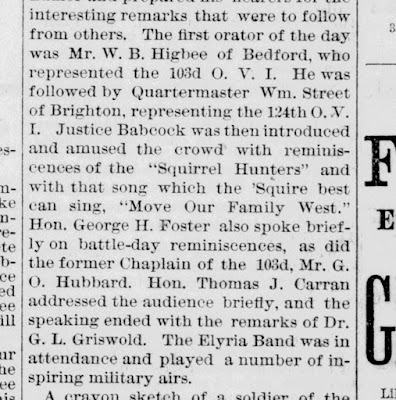
A few newspaper clippings, beside Peter Cherry's article, were in The Gazette and The Sentinel:


19 August 1881, p. 7 The Medina Gazette article on the reunion of the
124 O.V.I.


8 May 19087 Medina Sentinel  article detailing the state legislature granting a
stipend for the "Squirrel Hunters."

Medina Sentinel Apr 19 1912 p. 1

The state of Ohio has compiled a roster of the Squirrel Hunters, but the Medina Library doesn't have a copy of it.  The libraries that own copies of the index to the roster are listed on this LINK.


*Copperheads were generally Democrats who opposed the war.


For more information, view these links:
Oberlin Heritage Center

Ohio History Central

Library of Congress

Cincinnati Civil War Roundtable