The fourth in the series of Instructional Genealogy Research Blogs
- Guest Blogger: Lisa Rienerth, Medina Library Adult Reference Associate
The United States Census is an historical record of the entire U.S. population and one of the most extensive record sets for researching your family history. It provides a unique snapshot of your ancestor's lives and can provide a multitude of clues to extend your research.
A Brief History
The Census has been taken every ten years since 1790 through present times. The records are not made available for general public use until 72 years after they are taken. This is done to insure the privacy of the public. The 1940 census is the most recent census available and the 1950 census will be made available in April 2020.
The census is taken to provide an accurate population count which is used to provide the correct number of U.S. representatives for each state. It is also used to help estimate the amount of taxes to be collected. Some of the earlier census were used to count the number of available men for a standing army.
 |
| Photograph from the U.S. Census Bureau |
Keep In Mind
The people hired to go through the neighborhoods to take down the information were called Enumerators. Many of these enumerators were uneducated and mistakes did happen and houses were skipped. You have to remember that some of the enumerators were collecting information in areas that were quite rural and some times it was easier to just ask one of the farmers in the area to give the information for all of the other families near his farm.
Be Prepared
Choose one family to research at a time. Make sure you know as much as possible about the family before you begin, i.e. ages, place of residency, names of children, etc.

Have at least 5 different ways to spell the surname. You have to keep in mind that surnames were not spelled the same every time it was written. The enumerator sometimes just wrote it phonetically or sometimes families just wrote it any way they thought it should be and sometimes not the same way twice. Don't be confused if it isn't spelled exactly the way you think it should be and don't be surprised if the person you are searching for goes by his or her middle name or even a nickname. You can use the information you already have on the person or family (birth dates, children's names, etc.) to confirm it is the family you are searching for.
Where To Find Them
 |
| Photograph from the U.S. Census Bureau |
The easiest way to search the Census records is to do it from a genealogy website. That's not to say there aren't other ways. Some libraries, the Medina Library included, have some of the census records on microfilm. It's just simpler if you can use a search engine to find the record you want. The top three that I use are,
FamilySearch.org,
Ancestry.com and
Heritage Quest.
Family Search can be searched from any computer anywhere and is a free website. You need a subscription to search on
Ancestry.com. However,
Ancestry Library Edition is available for use within libraries and archives as long as it is one of their databases.
Heritage Quest is usually available through a library or archive, but can be accessed even when not visiting that repository. The Medina County District Library's branches have both Ancestry Library Edition and Heritage Quest available for our members.
A Few More Things...
1. As with all genealogy research, you begin with the most recent date and work your way back.
2. All of the information you find is important to add to your family history, not just the vital statistics.
3. The information you find in the most recent census will give you clues on how to find other records including older census records. I am going to highlight which columns will hold this type of information.
4. Each census contains different requested information and the farther back in time we go, the less information is requested.
Let's Begin!
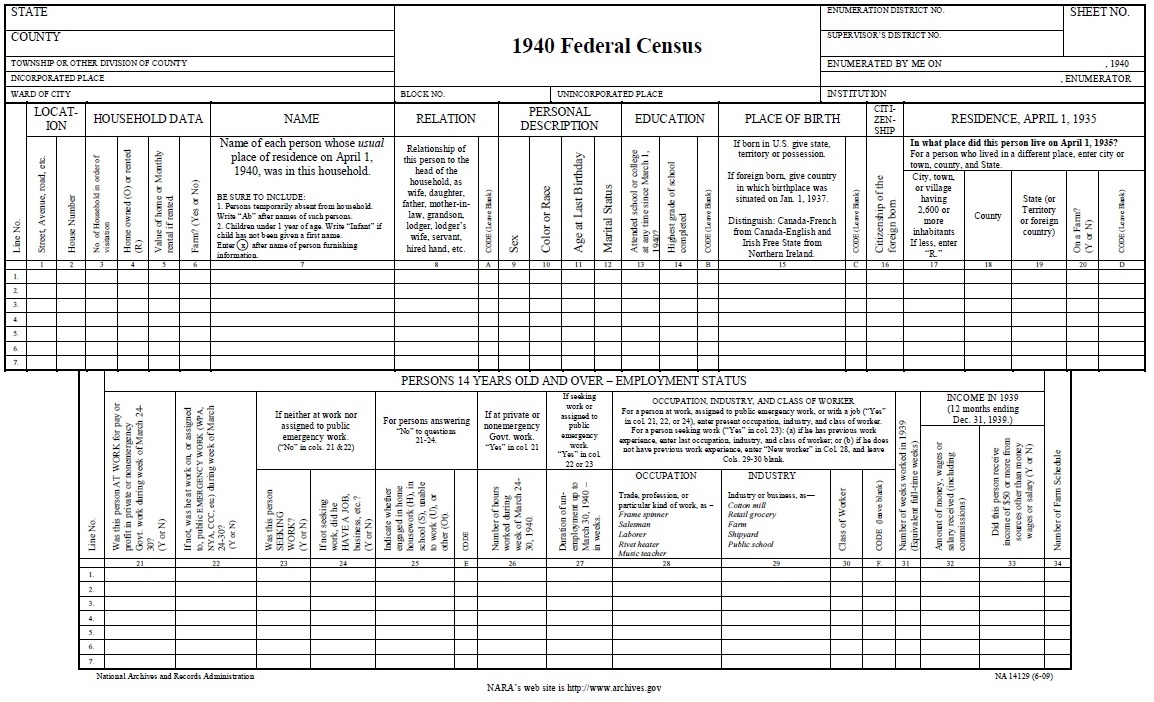
Every census has a date the enumerator was supposed to use when asking about information. In the 1940 Census, the family was to answer every question as if the date were April 1, 1940, no matter if the date was after that or not.
A blank census form will help you decipher what information you are seeing on the sheet. You can find them on
FamilySearch.org or
Ancestry.com.
In the left hand corner of the census form you will find the state and county which is being enumerated. This is one of the clues to where to look for additional records.
Columns 1 & 2 shows the address and
column 4 shows whether the house is owned or rented.

- If the property is owned, there should be property records. You can search for land or deed records and use the address to aid in this research.
- Sometimes the information you find in a deed can be a gold mine. You might find a spouse, children and other relatives listed.
Columns 7 & 8 - Name & Relation
- Check every name & relation. Make sure it is the family you are searching for.
- Look for different surnames listed in the household and check their relation to the head of household. These might give you clues to maiden names of the female relatives. For example, if the person listed is the male's head of household's father-in-law, the father-in-law's surname would be the head of household's wife's maiden name.
- Don't disregard the family if there is or isn't a name you recognize. Sometimes a family member is forgotten to future generations for one reason or another. It will be up to you to find out what happened to this family member.
Columns 9-12
- The age will give you the approximate birth year. This will help when searching for other vital records, such as birth and marriage records. It will also help in finding earlier census records.
- If the person is listed as a widow/widower in the marital status column this gives you a heads up to look for a spouse in an earlier census and to look for a marriage record, possibly in the county and state they are enumerated in.
Columns 15 & 16 - Birth & Citizenship

▶ This information shows if your family member was born in a different place other than where they are in 1940. You will search for earlier census records in the place of birth.
► It gives you clues to the family's migration, which leads to more places to search for records, including immigration records.
►Be alert to the child's birth place, it will show you where the family lived at certain dates. For example: a child is 10 years old in the 1940 census in Ohio, but it states that he was born in New York. Now you know that the family was living in New York at least 10 years ago.
►Sometimes the place of birth changes with census records. This adds another place to search for records. It also means you need to find a different source to confirm the place of birth.
►The citizenship column asks if the person was foreign born and if so what was the country's name before 1937. The country's names in Europe were constantly changing after World War II began so the census gives the name before the war started.
►It also distinguishes between French & English Canadian and Irish Free State & Northern Ireland. This will help narrow down the area you need to search for records.
►If the person is foreign born it will list the following:
- Na - Naturalized
- Pa - Having first papers
- Al - Alien
- AmCit - American Citizen
If the person was Naturalized or having First Papers you can look for the naturalization record or the First Papers. If the person is listed as an Alien, you know they have yet to file for naturalization.
Columns 17- 19
►Helpful in finding records for families between the 1930 & 1940 census.
►If they lived in a different place in 1935 you may be able to find more records there.
Columns 21-22
►Due to the Depression and Government Work, the government wanted to know more about employment status.
►If you find that your ancestor worked for these agencies you can search the
personnel records through the NARA (National Archives and Records Administration).
Columns 28-33 - Employment Status
These listings may not provide information that will help find vital records for your ancestor but it will add to the story of your ancestor. Remember genealogy isn't just vital records, it is also history of the life your family member lead.
Lines 14 or 29 - Lucky You!
If your ancestor happened to be listed on the Lines 14 or 29, then there is additional information for you to find. These people are listed at the bottom of the schedule in Column 35.
Columns 36 -38 - Place of birth of father and mother and "mother tongue"
- This will lead you to different areas to search for records, i.e. vital records, land records, census records.
- If they are foreign born you can start searching for possible immigration and naturalization records. Lauren Kuntzman will explain how to do this type of research in her May Blog.
Columns 39-41 -
Veterans
- If the answer is Yes to column 39 & 40 and which conflict in column 41, this will help in finding military records. Kathy Petras will be covering military research in her June Blog.
 Column 42 - Social Security
- If the answer is yes, than you can request a copy of their Social Security application, if the person is deceased.
Columns 48-50 - For all women who have been married
- If she answers Yes, that she has been married more than once, you need to search for her other marriage record. You start by looking for it in the current county she is residing in.
- You can use the age at her first marriage to figure out what year she was married. Just take her age now and subtract her first marriage age and then subtract that number from 1940. For example: She is listed as 50 years old in the census and she lists 20 years old as her age at her first marriage, when you subtract 20 from 50 you get 30. Then you subtract 30 from 1940 and 1910 would be the approximate year that she was married.
- Remember if she said she was married more than once, this marriage record may be with someone other than who is listed as her husband in 1940.
- The number of children ever born also includes the children who have died after they were born. This may lead you on a search for a child that no one ever talked or knew about. You can search for them in previous census records or try to find a birth or death record using the parent's names.
That was fun! Right?
Now you are going to use some of the information you learned from the 1940 census to help find your relative in the 1930 census. For example, if your relative lived somewhere different in 1935 according to the 1940 census, this is where you should begin searching for them. If they are listed as living in the same place you start searching in the same county and state for 1930.
You will find as you go back in time with the census records, that each census is a little different than the others. Sometimes the same question is asked, but the column is located in a different place on the schedule. Sometimes the information requested is the same on the previous census, so I am only going to go over the questions which are different and how you can use this information to find other records or why it is important for your research.
1930 Census
The first difference is the census date. This time the enumerator asked the questions as if it were April 15, 1930.
Column 9 - Does the household have a Radio Set?
 |
| Photograph from the U.S. Census Bureau |
This question was asked to see the feasibility of using the radio as a method of selling consumer items and as mass communication for a national emergency. It is not a question that will aide in finding other records, it is just kind of neat to see if your family owned a radio in 1930.
The following questions I am listing are different only because they are being asked to everyone, not just two people picked off the schedule. You can use the same methods I mentioned above to find the records.
Column 15 - Age at first marriage
If you see a difference in time span between the age the person presently is and the age they were at their first marriage compared to their spouse, this may indicate a second marriage and another record you need to find!
Example:
Clarence Swanson is 34 years old in 1930 and was 32 years old at the time of his first marriage. This means he was married for the first time around 1928. His wife, Sadie is 39 years old in 1930 and was 16 years old at the time of her first marriage. This means Sadie was married for the first time in about 1907. Sadie has another husband in her past.
Columns 19 & 20 - Place of birth for Father & Mother
By knowing the parents birth place, you can now search for the following records:
- Immigration records if foreign born.
- Earlier census records.
- Birth records.
Column 22- Year of Immigration
It is extremely helpful to know the year your ancestor immigrated to the United States, because now you have a time period to look for these records.
Column 30 & 31 Veteran and What War?
This data will help when searching for Military records.
This census is very similar to 1930. The census day is now January 1st, 1920 and there is only one additional question that will help in your research. The other information you will use the same way you did with the 1940 & 1930 census.
Column 15 - If Naturalized & Year of Naturalization
This narrows down the time period of when your relative was naturalized. For example, if he/she were naturalized in 1918, it is more likely you will find the record in the county they are enumerated in 1920. However, if you cannot find it in that county, then check the county where they were listed in the 1910 census.
1910 Census
The census day is now April 15th, 1910.
Column 9 - Number of Years of Present Marriage

- Take this number and subtract it from 1910 and find the approximate marriage year to aid in finding the marriage record.
Column 10-11 - Number of children born & Number of children now living
- Use these columns to make sure you have an account of all the children in this family, living or deceased, at the time of this census. The living children not named in this census may be living some where else and are enumerated in another 1910 census or an older census record. The children who have died may also be listed in previous census records.
- Now you also need to look for birth and death records for the unknown children.
Column 30 - Whether a survivor of the Union or Confederate Army or Navy?
- Again, this is helpful for Military records.
1900 Census
Census day is June 1st, 1900.
This is one of my favorite census...yes, I have a favorite census record. This is why....
Column 7 - Date of Birth
- Not only does it list the persons age, but the month and year of their birth. This comes in handy when looking for birth records, especially if you are having problems with persons of similar names. For example, two John Smiths born in Medina County, Ohio, in 1880. By using the month you can possibly eliminate a John Smith.
- It also helps fill in those pesky blank spaces on your Family Group Sheet.
Column 18 - Naturalization
- This gives you the date of your ancestor's naturalization. You can use this date to find his/her naturalization papers. Use the census records to see where they were living around the date of the naturalization and search in that county for the record.
1890 Census
Census day is June 2nd, 1890.

This is the sad census. Most of it was destroyed by fire and water damage in the Commerce Department where it was stored. Less than 1% survived.
Here is a list of places where fragments are found:
Alabama—Perry County
District of Columbia—Q, S, 13th, 14th, RQ, Corcoran, 15th, SE, and Roggs streets, and Johnson Avenue
Georgia—Muscogee County (Columbus)
Illinois—McDonough County: Mound Township
Minnesota—Wright County: Rockford
New Jersey—Hudson County: Jersey City
New York—Westchester County: Eastchester; Suffok County: Brookhaven Township
North Carolina—Gaston County: South Point Township, Ricer Bend Township; Cleveland County: Township No. 2
Ohio—Hamilton County (Cincinnati); Clinton County: Wayne Township
South Dakota—Union County: Jefferson Township
Texas—Ellis County: S.P. no. 6, Mountain Peak, Ovila
Precinct; Hood County: Precinct no. 5; Rusk County: Precinct no. 6 and J.P. no. 7; Trinity County: Trinity Town and Precinct no. 2; Kaufman County: Kaufman.
You can search these records on both
Ancestry and
FamilySearch.
If you are lucky enough to have a relative listed in these surviving records, this is the additional information you will find.
Line 2 - Veteran or Widow of a Veteran of the Civil War
- Again this will help with looking for Military records and Pension records.
Line 8 - If married within the census year
- If your person was married between 1 June 1889 - 31 May 1890, you now know to look for a marriage within this year and most likely within the county they are enumerated in 1890.
Lines 22 & 23 - Personal Health
- This information may help lead you to some lesser used sources, i.e. hospital, special school or institutional records. These records are hard to find and sometimes not open to the public.
- Even if you cannot find these resources, it does add that additional personal information for your relative.
The above information is also is true for
Line 24, which is whether your ancestor was a
prisoner, convict, homeless child, or pauper.
Census day is once again June 1st, 1880 and will continue to be June 1st until the 1820 census.
The 1880 census has just one question that is slightly different than the 1890 question.
Column 7 - Birth date
- Like the marriage question in the 1890 census, if the person was born within the census year, then a month was given.
- Remember, with this census, the census year isn't January through December 1880. It is 31 May 1879 through 1 June 1880.
Information to remember when using the 1870 census.
- Due to the end of the Civil War, many former slaves are now enumerated. They could possibly be using their former owner's surname.
- Column 20 is an interesting question. It askS if the male U.S. citizen of 21 years of age and older was denied the right to vote. This is due to the passing of the 15th amendment after the Civil War.
- The address and street number are no longer enumerated.
- The relation to the head of household is no longer given. Don't assume the man and woman listed together are man and wife. They could be siblings, in-laws or unrelated. The children listed may not be related to the head of household or to the woman listed in the household.
- The place of birth for the person's parents is no longer listed. There is only a hash mark if they are foreign born.
1860 & 1850 Census
These were the first of the census records that began listing everyone in the household. There is a lot less information requested, but you still find enough to aid in further research.
- If you see a male relative listed in the 1860 census, and is of an age to have fought in the Civil War, and he is not listed in the 1870 census, this man may have died in the war. This can lead you to search for military and pension records and possible death records.
- You will notice at the top of the form, on the left, it states "Free Inhabitants.." there are separate slave schedules in 1850 & 1860.
1790 through 1840 census....the early years...
These census aren’t detailed, but provide valuable information of where you can continue your research.
It does place the family in a specific area and it will help to distinguish your family from others with the same name, by comparing ages of people in household with what you have recorded. You can also locate possible additional relatives with the same surname.
Here is some information to keep in mind when using them for research.
- Only Head of households are listed with other occupants of the household indicated by a hash mark that coincides with a span of year. For example, male between 10-15.
- The people are also separated by sex and race.
- Beware that some people are listed alphabetically and some are listed as they were visited by the enumerator.
- The slave schedule is listed within these census records. It divides the slaves by gender & age. No owner's name is given.
- In the 1840 census, Pensioners for the Revolutionary War are also listed by name and age. This will help determine if your ancestor was in the Revolutionary War and if there may be both military and pension records.
- Census day for the 1790-1820 census was the first Monday in August.
- Enumerators for the 1830 & 1840 census were provided printed schedules to record the information.
- In 1790 through 1820 the enumerators had to provide their own schedules. Using a blank form is extremely helpful when researching these census, since many census takers did not label the columns.
- With all of the census between 1790-1840, be aware that the age breakdowns are different census to census.
- There are also some missing census records. You can check at FamilySearch.org to find out which ones are missing.
Now that you have gleaned all the information you can from these records take the time to compile and compare all the data for each family. You will find that the census provides a wealth of valuable information. However, you should not accept this information as proof of any fact or event. You use the census as a stepping stone to further research and to back up information you have already found and to add a little history to your family research.
Please let me know if you have any questions on these records.
Ancestry.com and
FamilySearch.org have some wonderful tutorials and articles on Census Records and I have listed a few resources below that provide additional information and aids to searching them.
Happy researching!
Sources:
Finding Answers in the U.S. Census Records - Loretto Dennis Szucs
The Source: A Guidebook of American Genealogy - Loretto Dennis Szucs & Sandra Hargreaves Luebking


 If you don't know where or when your ancestor died, you can use the U.S. Census to narrow down your search. This is another source you can find on online genealogy sites like the ones I mentioned above (this type of research was covered in the MCDL Genealogy Blog on 3 April 2019). If you find them in the census records and follow them through the decades, whenever you come to a year they are no longer listed, this may be a clue to where and when they died. For example, George Smith was found in the 1850, 1860 & 1870 U.S. Census in Montgomery County, Ohio. He is not located in the 1880 U.S. Census in Montgomery County, Ohio or anywhere else. This may be a clue that he died between 1870 & 1880 in Montgomery County, Ohio. This isn't a definite answer, but it does zero in your research to a smaller area.


 When you get home after your successful cemetery trip don't forget to download, identify & update as soon as possible! If you wait too long you will forget the details.